

Facing Prometheus | Week 33 (The Mysterion) | “Shoes and a Shield” | Pastor Jason Parrish
About the series: We’re currently in Facing Prometheus: A Letter to the Ephesians and the Future Church Dilemma, a 48-week look at how Paul’s letter to the church in Ephesus can transform our lives. For more on what the series is about, watch the prequel message here.
Last week covered the belt and the breastplate. This week takes the next two pieces: the sandals of the gospel of peace and the shield of faith.
Week 33 works verses 15 and 16, and it arrives at a claim that reorders the whole list. There is no order of priority in the armor, but there is one piece that everything else depends on, and if it isn’t up, nothing else functions.
The Text
Ephesians 6:10–16 (CSB) — Finally, be strengthened by the Lord and by his vast strength. Put on the full armor of God so that you can stand against the schemes of the devil. For our struggle is not against flesh and blood, but against the rulers, against the authorities, against the cosmic powers of this darkness, against evil, spiritual forces in the heavens. For this reason take up the full armor of God, so that you may be able to resist in the evil day, and having prepared everything, to take your stand. Stand, therefore, with truth like a belt around your waist, righteousness like armor on your chest, and your feet sandaled with readiness for the gospel of peace. In every situation take up the shield of faith with which you can extinguish all the flaming arrows of the evil one.
Every Occasion Has a Dress Code
What you clothe yourself with matters. Every occasion has a dress code, and it is no different with spiritual battles. The problem some of us face is that we don’t know how to dress for one.
This is the point Paul is making as he works through each item in the armor of God. There is no order of priority, but Paul also doesn’t flatten the armor into a single, undifferentiated whole. He looks at each piece to make sure the assessed value of each one is brought to the top of mind in the believer’s life.
★★ “Wearing the armor of God further distinguishes believers from those around them, as ones who seek holiness and justice, who practice kindness and forgiveness, and who humbly serve others above themselves.”
— Lynn H. Cohick, The Letter to the Ephesians, New International Commentary on the New Testament (Eerdmans, 2020), 417
1. “Your feet sandaled with readiness for the gospel of peace”
These were not ordinary sandals. When we hear the word, we picture something light, a few pieces of leather wrapped around the foot. What we know through study and archaeology is that these were robust. Leather, laced up the sides, with metal cleats on the bottom.
The sandals continue to carry through Paul’s injunction to stand.

★★ Standing is more difficult if your feet are not shod with the proper footwear.
“The soldier’s shoes are not the dancing slippers of this world or the lounging slippers of the slothful, but the shoes of the Christian warrior who knows Christ and makes Him known.”
— Lehman Strauss, Devotional Studies in Galatians and Ephesians (Loizeaux Brothers, 1957), 232–33
“These boots served for marching, especially in battle. Their function was like today’s cleated football shoe. They gave the foot traction and prevented sliding. Much ancient battle was hand-to-hand and foot-to-foot, like on the line of scrimmage, so these boots gave the Roman soldier an advantage over ill-equipped foes. The ‘readiness’ of our text pictures us being ready with our caliga firmly planted on solid ground. Thus established, the enemy is not going to be able to push us back. Rather, we are set to advance. The spiritual lesson here is perfectly clear. It is ‘the gospel of peace,’ the peace that comes to us in and through the gospel and makes us immovable in battle.”
— R. Kent Hughes, Ephesians: The Mystery of the Body of Christ, Preaching the Word (Crossway, 1990), 232
The spiritual battle we are in requires proper footwear, and that is the sandals of the gospel of peace.
Readiness
“The sandals were a sign of readiness, readiness to march and to do battle. The Roman sandals were made with nails that gripped the ground firmly even when it was sloping or slippery. The sign of the Christian soldier is readiness, a readiness to march and to bear witness to the gospel. Wherever the Christian soldier’s feet take him, he shares the gospel that can firmly ground a world reeling under the weight of desperate need and conflict.”
— Leadership Ministries Worldwide, Ephesians, The Teacher’s Outline & Study Bible (2010)
When everything else is shaking, the Christian whose feet are shod with the readiness of the gospel stands in the middle of a shaky world. When things get slippery, we have traction.
★★ “The noun is found only here in the New Testament; however, the cognate verb is used about forty times, always with the meaning ‘to prepare’ or ‘to get ready.’”
— Greek Lexicon of the New Testament
The believer’s feet are made ready through the gospel of peace because they have prepared well in understanding the gospel message.
★★ “They (believers) know the true word of peace gained through Christ’s work on the cross and can defend themselves against the devil’s lies.”
— Lynn H. Cohick, The Letter to the Ephesians (Eerdmans, 2020), 420
★★ “Better is to see ‘the gospel of peace’ as a whole complex as the source of the believer’s readiness, as Lincoln (449) expresses well as ‘the readiness or preparedness for combat and for standing in the battle that is bestowed by the gospel of peace.’”
— S. M. Baugh, Ephesians, Evangelical Exegetical Commentary (Lexham Press, 2015), 552
Across theologians, across traditions, across church history, the same thing keeps surfacing. The gospel of peace is what keeps us anchored when everything else is going crazy around us. This is not new information. It is old information that should still stun us.
Peace
So here Paul pairs the footwear with a promise we have in Christ.
★★ Peace.
It is a word we throw around, isn’t it? We talk about peace like it is just the absence of chaos, something we can achieve if we work hard enough, control our surroundings, or find the perfect app to quiet our minds. But the peace of Jesus is something entirely different. It is not a fragile truce with the world. It is a powerful, unshakable reality that transforms our lives from the inside out.
“Peace should be the object of your desire.”
— Augustine, Letter 189, to Boniface, sec. 6
But Augustine also reminds us that this peace isn’t something we manufacture. It is a gift from God, hard-won through the work of Christ. It is the kind of peace that doesn’t just calm the storm. It reorders our entire lives in harmony with God’s purposes.
★★ Here is the problem with the peace many of us are after. We want the kind of peace that calms the storm, but not the kind that reorders our life.
That is why you keep stepping back into chaos on Monday after God calmed the storm on Sunday. The disordered loves are still there. God wants to give a peace that reorders your thinking, your feeling, your priorities, everything about you.
“Peace among men is well-ordered concord.”
— Augustine, The City of God 19.13
True peace puts everything in its rightful place under the rule of the Prince of Peace. Prince is a rulership term, not a fairy tale term. To call Jesus the Prince of Peace is to say he is the authority of our peace. The government is not the authority of your peace. Gas prices are not the authority of your peace. Money is not the ruler of your peace, though many of us make it that. Only Jesus is the Prince of Peace.
“Peace is nothing else than the tranquility arising from order.”
— Thomas Aquinas, Summa Theologiae II-II, q. 29, a. 1, quoting Augustine, The City of God 19.13
Think about that. Peace isn’t passive. It is active. It is the result of God stepping into the chaos of our broken world and bringing his divine order. And here is the beauty: Jesus didn’t just preach about that peace. He is that peace. His presence in our lives creates a rhythm where justice, grace, and love flow together in perfect harmony.
★★★ Peace is not simply the absence of war, because we are in one. It is the presence of genuine harmony brought on by the peace of God.
Notice the juxtaposition Paul is making. He talks about the gospel of peace in the middle of a discourse on spiritual battle. Peace is not the absence of the thing you are in. Peace is what you receive from Jesus in the middle of the thing you are in.
Jesus doesn’t just remove conflict. He restores what is broken. His peace isn’t a band-aid. It is a total healing of our hearts, our relationships, our view of the world, and our view of ourselves.
But how?
“Peace means giving oneself completely to God’s commandment.”
— Dietrich Bonhoeffer, “The Church and the Peoples of the World” (Fanø, Denmark, August 28, 1934), in No Rusty Swords (Harper & Row, 1965), 241
Real peace isn’t found in the absence of problems but in surrender. The peace of Jesus requires us to lay down our need to control, to demand guarantees, and to trust him fully. You don’t half-heartedly give yourself to his commands. There is an absence of peace wherever there are disordered loves.
Romans 5:1 (ESV) — Therefore, since we have been justified by faith, we have peace with God through our Lord Jesus Christ.
Philippians 4:4–9 (ESV) — Rejoice in the Lord always; again I will say, rejoice. Let your reasonableness be known to everyone. The Lord is at hand; do not be anxious about anything, but in everything by prayer and supplication with thanksgiving let your requests be made known to God. And the peace of God, which surpasses all understanding, will guard your hearts and your minds in Christ Jesus. Finally, brothers, whatever is true, whatever is honorable, whatever is just, whatever is pure, whatever is lovely, whatever is commendable, if there is any excellence, if there is anything worthy of praise, think about these things. What you have learned and received and heard and seen in me—practice these things, and the God of peace will be with you.
Be reasonable, people. We need more reasonableness in the world. And do not be anxious about anything. Those aren’t preacher’s words, those are the text’s words. Say that now and you get cancelled, because we love our anxiousness. We let anxious define us more than the blood does. There is a peace from God that surpasses your own understanding, and when it doesn’t make sense and doesn’t add up, it still guards your heart and your mind in Christ Jesus.
We are all searching for peace, especially in this moment: culturally, socially, politically, technologically. When everything is fast-paced, hectic, and somewhat out of control, we look for calm, control, and composure. The problem is that we rarely, if ever, find it.
So here is the good news: peace has come. It is Jesus. And there are two types of peace.
- Peace with God (Romans 5:1, which we have already read)
- Peace of God (John 14:27)
John 14:27 (CSB) — “Peace I leave with you. My peace I give to you. I do not give to you as the world gives. Don’t let your heart be troubled or fearful.”
The world gives and then wants it back. The world gives on condition. Jesus does not give the way the world gives. This is the gospel of peace Paul speaks of when he tells us to sandal our feet.
2. “In every situation take up the shield of faith with which you can extinguish all the flaming arrows of the evil one”
The shield was typically two pieces of wood brought together and rounded, running almost the full length of a soldier’s body. The Roman soldier held it in front of him as he advanced.
They had another maneuver with it. In English we call it the turtle. Soldiers would form a square with their shields in front of them, and the soldiers in the middle would raise their shields overhead, and the whole formation would move forward against the enemy without being hit by flaming arrows, because they were covered.
They also wrapped the front of the shield in linen, covered it in leather, and soaked it in water. So every time a fiery dart hit, the water-soaked shield put the fire out. It was almost unstoppable.
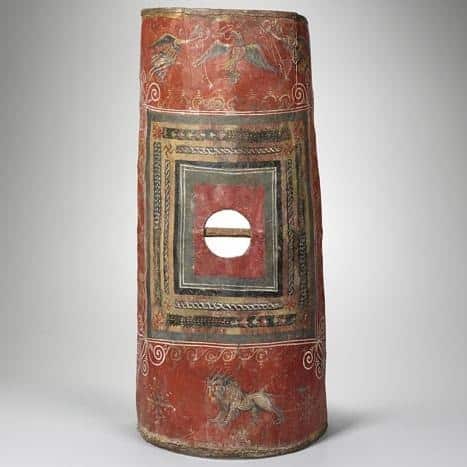
★★ Does your Christian life look like this? Grab your shield. Put your sandals on. Get with others who have their shields and their sandals on. Become a turtle. Guard each other, because darts are flying.
“The imagery of the shield also resonates with the protective stance of the Lord, who promised Abraham, ‘I am your shield’ (Gen 15:1). For Israel, ‘He is the shield that protects you’ (Deut 33:29), just as David calls him ‘my shield, the horn of my salvation,’ and ‘a shield to all who take refuge in him’ (2 Sam 22:3, 31; see also Pss 3:3; 7:10). Protection from attack is an expression of the Lord’s love and care for his people. Faith, trust, or confidence in God’s loving care is the effective defensive protection that will keep believers safe from attack.”
— Constantine R. Campbell, The Letter to the Ephesians, Pillar New Testament Commentary (Eerdmans, 2023), 288
The shield was one of the most important pieces of a Roman soldier’s armor. But these items are not presented in a way that implies an order of importance. It is simply a list of what makes up a whole. Chrysostom, however, has a curious take on the shield. He submits that faith is what must be had in order for everything else to be assimilated. Faith is what receives the blows of the enemy first, before anything else.
★★ “The shield is that which first receives the assaults of the adversary, and preserves the armor uninjured. So long then as faith be right and the life be right, the armor remains uninjured.”
— John Chrysostom, Homilies on Ephesians, hom. 24, NPNF 1st ser., vol. 13 (Christian Literature, 1889), 168
Faith is what receives the first wave of attack. The shield of faith goes up to take that first volley of fiery darts. Without faith, the other parts of the armor are rendered ineffective.
- Truth without faith becomes subjective, pliable, and open to the cultural winds of the world.
- Righteousness without faith becomes will-powered behavioral modification.
- Peace without faith is simply positive thinking, which is rattled when situations are no longer positive.
- Salvation without faith is impossible, because it no longer has the anchor needed to keep it secure in Christ.
- The Word without faith becomes letters and sentences in another book of ideas and history that gets placed on the shelf of life without any power or relevance.
But with faith, each item becomes a whole armor that is able to keep the Christ follower secure and solid in an ever-unfolding spiritual battle, able to stand therefore.
The Darts of Doubt
“Many things does the devil dart in to inflame our soul and bring us into uncertainty; as, for example, when some persons say, ‘Is there then a resurrection?’ ‘Is there a judgment?’ ‘Is there a retribution?’”
— John Chrysostom, Homilies on Ephesians, hom. 24, NPNF 1st ser., vol. 13 (1889), 169
What he has in mind is doubt. Doubt is a reality we all face. Paul has to address it directly.
1 Corinthians 15:1–8 (CSB) — Now I want to make clear for you, brothers and sisters, the gospel I preached to you, which you received, on which you have taken your stand and by which you are being saved, if you hold to the message I preached to you—unless you believed in vain. For I passed on to you as most important what I also received: that Christ died for our sins according to the Scriptures, that he was buried, that he was raised on the third day according to the Scriptures, and that he appeared to Cephas, then to the Twelve. Then he appeared to over five hundred brothers and sisters at one time; most of them are still alive, but some have fallen asleep. Then he appeared to James, then to all the apostles. Last of all, as to one born at the wrong time, he also appeared to me.
1 Corinthians 15:12–19 (CSB) — Now if Christ is proclaimed as raised from the dead, how can some of you say, “There is no resurrection of the dead”? If there is no resurrection of the dead, then not even Christ has been raised; and if Christ has not been raised, then our proclamation is in vain, and so is your faith. Moreover, we are found to be false witnesses about God, because we have testified wrongly about God that he raised up Christ—whom he did not raise up, if in fact the dead are not raised. For if the dead are not raised, not even Christ has been raised. And if Christ has not been raised, your faith is worthless; you are still in your sins. Those, then, who have fallen asleep in Christ have also perished. If we have put our hope in Christ for this life only, we should be pitied more than anyone.
Paul was addressing doubts beginning to arise in the Corinthian church, doubts that without faith would be difficult for them to reconcile and face. Important truths about the gospel, and specifically about the resurrection of Christ.
The truths of our faith are confessional in nature. They are confessed even when there is doubt. There is no problem with confessing your faith while you are in doubt. Faith is the confession of things you cannot see all the time but believe with everything you are.
“Faith is a shield; but wherever there are quibbles, and reasonings, and scrutinizings, then is it no longer a shield, but it impedes us.”
— John Chrysostom, Homilies on Ephesians, hom. 24, NPNF 1st ser., vol. 13 (1889), 169
“For faith lays hold of the promises of God in times of doubt and depression, and faith lays hold of the power of God in times of temptation.”
— John R. W. Stott, God’s New Society: The Message of Ephesians, The Bible Speaks Today (InterVarsity Press, 1979), 281
Friendly Fire
The shield serves another purpose. It defends against a different kind of dart.
“Most lethal arrows come from within our own camp. Unseen hands grasp the hands of our brothers and sisters, take their bows, dip them in tar, and with evil synergism send them flaming toward our hearts, arrows of rejection and criticism and hypocrisy. But the shield of faith goes up again. The Word of God has not left us ignorant of the human condition, but rather informs us about those ‘who sharpen their tongues like swords and aim their words like deadly arrows. They shoot from ambush at the innocent man; they shoot at him suddenly, without fear’ (Psalm 64:3, 4). Some of the arrows strike us, and they hurt, but the incendiary pain can be snuffed by the shield of faith. Through belief in God’s Word, we forgive.”
— R. Kent Hughes, Ephesians: The Mystery of the Body of Christ (Crossway, 1990), 235
★★★ In every battle there is friendly fire, which quite frankly hurts the worst.
How dare we shoot darts at our brothers and sisters. What about our Christian witness?
What Is Faith, Then?
★★ So here is the question: what is faith, and what does it look like to exercise it?
It is a giant question with many facets that can be discussed, debated, articulated, and examined. There is a lot of conversation around this topic, and not just in church circles. The problem with much of that conversation outside of historically orthodox applications is that it quickly drifts into superstition, good vibes, and fatalistic living.
★★ Faith is more than assent to a set of intellectual beliefs. It is more than wishful thinking and a serendipitous attitude.
★★★ Faith is a substantive truth that creates the bedrock on which we can stand.
★★★ The problem that so many of us face is that we see faith as Christian magic rather than substantive truth.
★★ “When we feel that we can’t see God at work, the author of Hebrews tells us to look to followers of God from times past as an example. If we look hard enough, God will eventually surface.”
— J. D. Barry, Hebrews: How Jesus Speaks into Everything (Lexham Press, 2014), 119
★★★ Faith is the ability to see God in everything.
★★ “Now Faith, in the sense in which I am here using the word, is the art of holding on to things your reason has once accepted, in spite of your changing moods.”
— C. S. Lewis, Mere Christianity (HarperOne, 2001), 140
The new world we are entering is a world of great uncertainty. It is one of changing moods and changing circumstances. So what is faith in the midst of a world with all this uncertainty and these changing currents?
The faith required for the world we are navigating is the same faith that was required from the beginning of time. Faith is the engagement of every faculty Jesus said represents who we are. To love God, Jesus said, requires mind, soul, heart, and strength. To love God is an act of faith, and it requires every part of who we are.
“Faith is not just belief; it is belief plus trust. It is resting in the person of God and his Word to us.”
— R. Kent Hughes, Ephesians: The Mystery of the Body of Christ (Crossway, 1990), 235
So here is the question. Do you believe in God, or do you trust him?
Think about Peter getting out of the boat. A lot of us think he stepped out on water. He didn’t. He stepped out on a word. Jesus said come, and Peter got out of the boat. That is faith.
Closing
“How awesome is the soldier whose feet are shod with ‘peace.’ He has peace with God and the peace of God. His heart is at rest before God, and he is filled with a sense of well-being. He sings from the heart, ‘It is well, it is well with my soul.’ The ‘shield of faith’ is ever before him. The burning arrows fly, sensuality, trials, jealousy, criticism, hypocrisy, vanity, but he stands victorious.”
— R. Kent Hughes, Ephesians: The Mystery of the Body of Christ (Crossway, 1990), 235
Verses 15 and 16 of Ephesians 6 tell us to put our shoes on, because they bring peace, and to lift our shield up, because faith is what we need to stand in the world we are navigating.
Bibliography
- Augustine. Letter 189, to Boniface, sec. 6. In The Confessions and Letters of St. Augustin, with a Sketch of His Life and Work. Edited by Philip Schaff. Translated by J. G. Cunningham. Nicene and Post-Nicene Fathers, 1st ser., vol. 1. Buffalo, NY: Christian Literature, 1886, 553.
- Augustine. The City of God 19.13. In St. Augustin’s City of God and Christian Doctrine. Edited by Philip Schaff. Translated by Marcus Dods. Nicene and Post-Nicene Fathers, 1st ser., vol. 2. Buffalo, NY: Christian Literature, 1887, 409.
- Barry, J. D. Hebrews: How Jesus Speaks into Everything. Bellingham, WA: Lexham Press, 2014, 119.
- Baugh, S. M. Ephesians. Evangelical Exegetical Commentary. Bellingham, WA: Lexham Press, 2015, 552.
- Bonhoeffer, Dietrich. “The Church and the Peoples of the World.” Address, Ecumenical Conference, Fanø, Denmark, August 28, 1934. In No Rusty Swords: Letters, Lectures and Notes, 1928–1936. Edited by Edwin H. Robertson. Translated by Edwin H. Robertson and John Bowden. New York: Harper & Row, 1965, 241.
- Campbell, Constantine R. The Letter to the Ephesians. Edited by D. A. Carson. Pillar New Testament Commentary. Grand Rapids, MI: William B. Eerdmans Publishing Company, 2023, 288.
- Chrysostom, John. Homilies on the Epistle of St. Paul the Apostle to the Ephesians, hom. 24. Edited by Philip Schaff. Translated by Gross Alexander. Nicene and Post-Nicene Fathers, 1st ser., vol. 13. Buffalo, NY: Christian Literature, 1889, 168–69.
- Cohick, Lynn H. The Letter to the Ephesians. Edited by Ned B. Stonehouse, F. F. Bruce, Gordon D. Fee, and Joel B. Green. New International Commentary on the New Testament. Grand Rapids, MI: William B. Eerdmans Publishing Company, 2020, 417, 420.
- Hughes, R. Kent. Ephesians: The Mystery of the Body of Christ. Preaching the Word. Wheaton, IL: Crossway Books, 1990, 232, 235.
- Leadership Ministries Worldwide. Ephesians. The Teacher’s Outline & Study Bible. Chattanooga, TN: Leadership Ministries Worldwide, 2010.
- Lewis, C. S. Mere Christianity. 1952. Reprint, New York: HarperOne, 2001, 140.
- Stott, John R. W. God’s New Society: The Message of Ephesians. The Bible Speaks Today. Downers Grove, IL: InterVarsity Press, 1979, 281.
- Strauss, Lehman. Devotional Studies in Galatians and Ephesians. Neptune, NJ: Loizeaux Brothers, 1957, 232–33.
- Thomas Aquinas. Summa Theologiae II-II, q. 29, a. 1.
